Discuss the Function of Extended Family Systems Within the U.s. Family Structure.
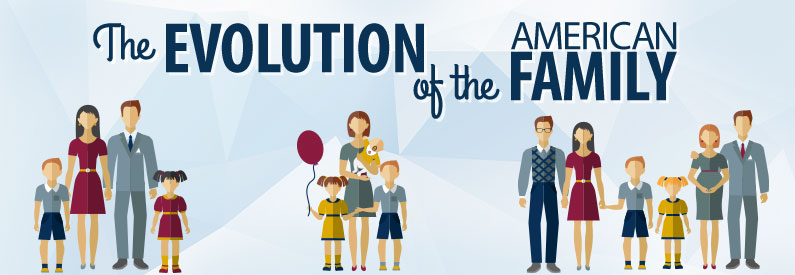
America'south mainstream culture evolves to reflect the predominant values of the day, including social systems such as the family. Instead of being 1 unit, the family unit institution has been in a constant land of evolution, according to California Cryobank. Today, there actually is no consistent definition of the American family. With single-parent households, varying family structures, and fewer children, the modern family unit defies categorization. But these most contempo changes accept brought with them a nostalgia-based myth: that divorce, domestic violence, and single parenthood are contempo phenomena. When the history of the American family unit was surveyed in-depth by Insider, it became apparent that this is non the case. Constant change and accommodation are the merely themes that remain consequent for families throughout America's history. In fact, recent changes in family life are only the latest in a serial of transformations in family unit roles, functions, and dynamics that take occurred over fourth dimension.
A Brief History of the Pre-20th Century Family unit
When America was founded, a family was defined as a hubby, wife, biological children and extended family unit (unfortunately, slaves were not considered role of whatever family). This meant that most people who could legally marry did, so stayed married until decease. According to Insider, in the 19th and early 20th centuries people often married to gain belongings rights or to motility social course. All of that changed in the 1800s, with the ideas of love and romance becoming the main reason to wed. Divorce was rare; History Collection reports that, "the process of getting a divorce was very expensive, and a judge would never allow it, unless it was the last resort .. If two people were unhappy in a marriage, they sometimes decided to quietly dissever in a mature, responsible fashion, merely they were legally still married, and could never remarry someone else, unless their start husband or wife died." Considering this structure was and so ascendant, information technology played a crucial office in the cosmos and replication of cultural roles for men and women. The role of wives was to assistance their husbands inside the domicile, both keeping house and raising children.
Wives had no legal identity under a condition chosen coverture; ThoughtCo explains that "legally, upon spousal relationship, the husband and married woman were treated as 1 entity. In essence, the wife's separate legal existence disappeared equally far equally property rights and sure other rights were concerned." Husbands, in contrast, were managers and providers in the family. They controlled finances and had ultimate authority in the eyes of both social club and the constabulary. This meant that "a husband could not grant to his wife anything such as belongings, and could not make legal agreements with her after matrimony considering it would be like gifting something to one'south cocky or making a contract with one's cocky."
Information technology was generally against the law to live together or accept children outside of spousal relationship. Withal, by the 19th century, coverture was less of an effect and these rigid legal boundaries were relaxed, with mutual-police union widely recognized as an acceptable matrimony.
Government and the Family unit
The 19th century brought virtually a number of important changes to the family, according to Shirley A. Hill'southFamilies: A Social Form Perspective. In the first half of the century, married women began to have holding rights through the Married Women's Property Acts, which began to exist enacted in 1839. By the early 20th century, most states permitted married women to "ain holding, sue and be sued, enter into contracts and control the disposition of belongings upon her death." However, during this time a woman's function in the family unit was still defined by her husband.
Another important development was regime regulation of some aspects of childhood, such every bit child labor and schooling. To improve the well-existence of children, "reformers pressed for compulsory school omnipresence laws, child labor restrictions, playgrounds … and widow's pensions to permit poor children to remain with their mothers." Despite these legal changes, the family became an even more important source of happiness and satisfaction. The "companionate family was envisioned as a more isolated, and more important unit — the primary focus of emotional life." New ideas about union emerged, based on option, companionship, and romantic love. This in turn caused a surge in the divorce rate, which tripled between 1860 and 1910.
Depression and War
The stability of families was tested by the Groovy Depression, as unemployment and lower wages forced Americans to delay marriage and having children. The divorce rate cruel during this time considering it was expensive and few could beget information technology. However, by 1940 nearly ii million married couples lived apart. Some families adjusted to the economic downturn by "returning to a cooperative family economy. Many children took part-time jobs and many wives supplemented the family income."
When the Low ended and Globe War II began, families coped with new issues: a shortage of housing, lack of schools and prolonged separation. Women ran households and raised children alone, and some went to piece of work in war industries. The results of the war-stricken state of society were that "thousands of immature people became latchkey children and rates of juvenile delinquency, unwed pregnancy, and truancy all rose."
Family Structures in the Postwar World
In reaction to the tumult both at home and away during the 1940s, the 1950s marked a swift shift to a new type of domesticity. Insider reports that "the thought of the nuclear, All-American Family was created in the 1950s, and put an emphasis on the family unit of measurement and marriage." This time period saw younger marriages, more kids, and fewer divorces. The average historic period for women to ally was 20, divorce rates stabilized, and the birth rate doubled. However, the perfect images of family life that appeared on television do non tell the whole story: "Merely sixty percent of children spent their childhood in a male-breadwinner, female-homemaker household."
This "democratization of family ideals" reflected a singular society and economy, one that was driven past a reaction against low and war and compounded by rising incomes and lower prices. The economical boom that followed World War II led to significant economic growth, particularly in manufacturing and consumer goods; around xiii million new homes were congenital in the 1950s. Families moved to the suburbs considering they could afford to, and the family became a "haven in a heartless world," as well every bit "an alternative world of satisfaction and intimacy" for adults and children that had experienced the ravages of wartime. In fact, this is where the concept of shut-knit families equally we know it originates. Domestic containment every bit a way of life was reinforced by American youth, who wanted to take long-lasting and stronger relationships than their parents had. Soldiers and servicemen who returned from war were looking to get married and raise children.
The Idyllic '50s
The standard construction of the family unit in postwar America consisted of a breadwinner male, his married woman who did household chores and looked after the children, and the children themselves. Families ate meals and went on outings together, and lived in sociable neighborhoods. Parents paid close attending to disciplining their children and live-in relationships were unheard of — in fact, girls stayed in their parents' home until union and did not commonly attend college. Children became emotional rather than economic avails for the beginning fourth dimension, shut with their parents and the eye of the family. Considering of this, parents studied kid development and worked to socialize their children then that they would become successful adults. Childhood became a distinct period of life. However, young girls were supposed to be housewives instead of educated professionals.
All in all, family structure in the '50s was based effectually one cardinal necessity: a secure life. The economic and global instability of the early 20th century gave ascent to the need for closely defined family units. This led to an ideology that lauded economic advancement and social order, the results of which were younger marriages that lasted longer, more than children, fewer divorces, and more than nuclear families.
The Modern Family unit Unit
The nuclear family of the '50s epitomized the economically stable family unit. The idea of the middle-class, patriarchal, child-centered families were curt-lived. This is why the modern family, in virtually cases, bears piddling resemblance to this "ideal" unit. Many of the changes that were role of this transition are a directly result of the expanding role of women in society, both in terms of the workplace and educational activity. The rise of the post-industrial economy, based in information and services, led to more than married women entering the workplace. As early every bit 1960, effectually a third of center class women were working either part-time or total-time jobs. Since the '60s, families have also get smaller, less stable, and more than diverse. More adults, whether young or elderly, live outside of the family besides. Today, the male-breadwinner, female person-housewife family unit represents but a small percentage of American households. A considerable majority of Americans (62 pct) view the thought of matrimony as "1 in which husband and wife both work and share child care and household duties." Two-earner families are much more common also. In 2008, the U.Southward. Bureau of Labor Statistics reported that women made upwards most l pct of the paid labor force, putting them on equal ground with men when it comes to working exterior the home. In addition, single-parent families headed past mothers, families formed through remarriage, and empty-nest families have all go part of the norm.
Along with these shifts have come up failing union and birth rates and a ascent divorce rate. The American nativity rate is half of what it was in 1960, and striking its lowest point ever in 2012. In improver, the number of cohabiting couples increased from less than one-half a one thousand thousand in 1960 to four.9 meg in the 2000 census. According to the 2005 American Community Survey, more than fifty percent of households in America were headed past an unmarried person during that year. And past 2007, almost 40 percent of children were born to unmarried, adult mothers. One reason for these developments is that marriage has been repositioned as a "cornerstone to capstone, from a foundational human action of early machismo to a crowning effect of later adulthood." It is viewed every bit an upshot that should happen after finishing higher and establishing a career.
Farther Change in the Marital Family
A number of historical factors contributed to shifts in how Americans perceive and participate in family structure. According to the American Bar Association, in 1965, the Supreme Courtroom extended constitutional protections for "various forms of reproductive freedom" through its ruling inGriswold five. Connecticut. There were too medical advances in contraception, including the invention of the nascency control pill in 1960. Equally a result, the mode children were brought into families became more varied than ever earlier. Divorce changed during the '60s as well. In 1969, California became the first state to adopt no-fault divorce, permitting parties to terminate their union simply upon showing irreconcilable differences. Inside 16 years, every other state had followed suit.
Included in these trends is the expansion of rights granted to aforementioned-sex couples. With the decline of barriers to lesbian and gay unions and the increment in legal protections, more LGBTQ populations are living openly. Gay marriage was legalized in 2015; However, for some legal purposes these relationships are withal not treated like marriages. Still, in general, families are more racially, ethnically, religiously, and stylistically diverse. However, all of this alter does not mean that the family unit is a dying institution. About 90 percent of Americans still marry and have children, and those who divorce normally remarry.
The Role of Family unit Science
Many who are interested in family unit development and culture cull to pursue a career in family science. With an accent on current issues and skills for living successfully in today'south gild, this applied science is constantly evolving, much like the family units that are its area of study. It is a discipline including contributions from related academic areas such as law, folklore, psychology, anthropology, healthcare, and more. Because of this, professionals in the field practice in a multifariousness of contexts, including:
- Education
- Inquiry
- Community outreach
- Human services
- Nutrition
The field of family science plays an of import role in navigating the implications of today'southward global society. Though the families of today have lilliputian in common with those in previous decades and centuries, family science professionals have a articulate perspective on how to approach the complexities of a constantly evolving establishment. And these skills will only become more than valuable equally families continue to evolve.
Next Steps: Family unit Science Degrees at Concordia Academy, St. Paul
Concordia Academy, St. Paul offers online family unit scientific discipline degree programs at both the undergraduate and graduate level. The comprehensive education students receive through these programs allows them to become practitioners in this dynamic and interdisciplinary field. Because both of Concordia'due south family science programs are approved past the National Council on Family Relations (NCFR), students are also prepared for a wide variety of careers after graduation. To acquire more virtually these online degree programs, visit their program webpages.
Source: http://online.csp.edu/blog/family-science/the-evolution-of-american-family-structure
0 Response to "Discuss the Function of Extended Family Systems Within the U.s. Family Structure."
Post a Comment