The Book of M a Novel by Peng Shepherd Reviews

A Review of Peng Shepherd'south "The Book of M"
Shadow of a Idea
When I was in Grade 9, the volume on the curriculum for my advanced-level English grade was Ursula Thou. Le Guin'due south A Sorcerer of Earthsea. The book is virtually a young sorcerer who loses his shadow and takes off to fight it and then that it doesn't do irreplaceable damage every bit it gallops all effectually the world doing evil deeds. I'one thousand going to spoil the ending of that book hither but spoil it I must. Instead of a final confrontation with the shadow, the wizard winds upwards grafting the shadow back onto himself through magic. The reason I bring this up is because everyone in my class thought this ending was a huge cop-out, including me. The instructor desperately tried her all-time to testify the form why it was the only possible ending, and it was a practiced one. Notwithstanding, for a class weaned on Hollywood action films, the ending to A Wizard of Earthsea was not the preferred ending we would have liked to have seen. It needed more than bang for the buck, a terminal showdown where the shadow was vanquished.
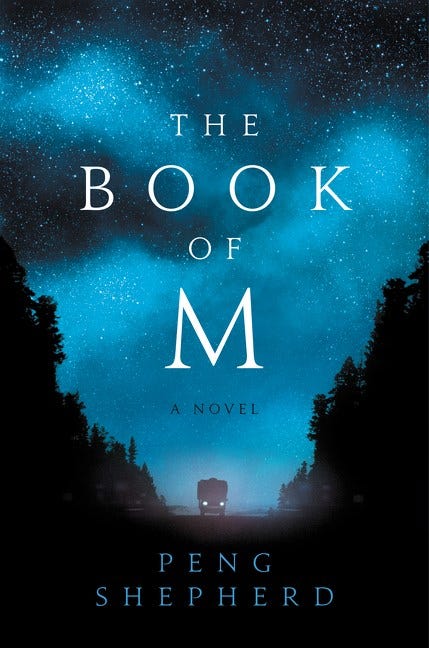
Funny that I mention A Wizard of Earthsea in reviewing The Volume of Grand, because the two novels are joined at the hip in subject thing: losing shadows. In The Book of M, society has broken down entirely equally people all around the globe start losing their shadows permanently. Thus, it is with no irony that I written report that a major character of this work is named Ursula in accolade of a detail author. (Ahem!) Yet, the story actually centers on a married couple named Maxine and Orlando, who are holed up in a remote hotel in Virginia. Maxine suddenly loses her shadow at the outset of the novel, and this is a bad thing because those who lose their shadow proceed to lose their entire memory — thus, the shadowed and the shadowless are in perpetual war with each other. So Max decides to leave the hotel and then that she doesn't injure Ory, as he'south also known as, past the effects of losing the shadow. You meet, the shadowless as well have this curse of transmuting everyday ordinary objects and living things into weapons as they start to forget. Despite the dangers involved, Ory takes off after Max, but is headed in the opposite management. It turns out information technology doesn't matter likewise much considering in that location is a mysterious effigy in New Orleans, an amnesiac who lost his memories only before anybody else started losing their shadows, who is gathering things — people or other materials — for some special purpose. Similar moths to a flame, the story eventually starts tugging the characters towards New Orleans.
That's a lot to summarize, and I'yard probably not doing the book much justice. The reason is because this is a deeply layered book. Once y'all've figured out what's happening to the characters and what something might mean, another layer is revealed and more than questions are asked than are answered. Those who love brain puzzles volition find much enjoyment in The Book of M, which is impeccably well-written and is literary dystopian fiction in the vein of Station 11. Alas, the volume eventually does not succeed in property one'southward interest because, at almost 500 pages, it is overlong and, by the mid-fashion point, things start getting sillier and sillier. Peng Shepherd, the book'south writer (making her debut hither), has a penchant for writing her characters into corners that are inescapable, meaning that they have to rely on magical powers that they don't really know that they accept to suspension complimentary of their confines. In that location are plot twists that you don't meet coming, just they, likewise, may make your eyeballs roll. Elephants as well play a large role in this book, and, when you find out why, you lot may groan in disbelief. Also, at that place'south a climax, but information technology feels too muted and the enemy too easy to fight off. It feels a bit similar a riff off that other book I was just talking virtually.
Even though The Book of One thousand never elevates itself as a good kickoff novel by someone still figuring out how to write a novel, there are pluses with this piece of work. The biggest is that the characters are delightfully multi-ethnic — Max and Ory are a racial intermarriage — and the LGBTQ community has a big function to play in the piece of work. Most of these characters are three-dimensional, real people, and Shepherd has skillfully fleshed them out. Indeed, the characters may exist themselves the biggest draw of the novel, considering the settings — mostly in the United States — do not feel fully realized. It's hard to imagine what the setting might exist similar if you lot haven't been the particular places that the author has visited, which is peculiar for a volume that is as long as this. There are trade-offs to be had, for sure.
All in all, I found The Volume of One thousand to have a crackling good start, a ponderous mid-section and an unintentionally hilarious finale. It is an boilerplate book, at best. Still, it's worthy of a adept beach read if y'all're looking for ane, equally you lot don't have to actually think about it too much — except when information technology gets a footling too outlandish for its premise. (The Statue of Liberty attacking New York City. Actually?) It is an entertaining book. With a little pruning and a niggling more than attending paid to the setting and the magical realist aspects of the premise, The Book of M would have been a stand-out read. What's hither is merely adequate. However, mayhap I feel this way because I wasn't enchanted with A Wizard of Earthsea when I was 14 years quondam. Maybe I didn't like this volume every bit much as I should have because I'k still biting when it comes to books nearly shadows been ripped from one'south body. It'south a proficient concept. Now someone has to execute it so that the resolution to these stories have a scrap more zip and prisoner of war to it, and non but having the reader sigh at the finish, "Oh, come on! That's information technology?"
Peng Shepherd's The Book of Thousand was published past William Morrow Books on June 5, 2018.
Of class, if you like what you see, please recommend this slice (click on the clapping easily icon beneath) and share it with your followers.
Source: https://medium.com/@zachary_houle/a-review-of-peng-shepherds-the-book-of-m-8e6e7cb77fe2
0 Response to "The Book of M a Novel by Peng Shepherd Reviews"
Post a Comment